
Guide
How attachment styles change over time — and why yours differs by circle
Your attachment style is not a permanent label — it is a set of learned responses that shifts over time and varies by relationship. You can be secure with a close friend, anxious with a partner, and avoidant with a parent in the same week. What matters is not the label but the drift: whether your activation, withdrawal and stability signals are rising or settling, and in which circle.
12 min read · Updated 01 August 2026
One label is the wrong unit of measurement
Most attachment content online asks you to answer twenty questions and receive a noun: anxious, avoidant, secure, disorganised. The noun feels satisfying. It is also the least useful part of attachment theory, because it collapses a moving, context-dependent set of responses into a single word that then follows you around like a diagnosis.
Research on adult attachment has been clear for decades: style is measured on continuous dimensions — anxiety about abandonment and avoidance of intimacy — not as four boxes. Scores move. They move with life stage, with stress load, with who you are sitting across from, and with the accumulated experience of being met or not met when you reached for someone.
What actually changes, and over what timescale
Attachment change happens on three different clocks, and confusing them is why people conclude that nothing ever changes.
The moment (minutes to hours)
State attachment. A slow reply, a flat tone, an unresolved argument — and your activation spikes or your withdrawal engages. This is not your style changing; it is your style firing.
The season (weeks to months)
This is where real, observable drift lives. A new job, a bereavement, a move, a period of consistent repair with a partner — and your baseline shifts. Most people can see meaningful movement across a 60-to-90-day window if they are recording anything at all.
The arc (years)
Earned security. Long exposure to a partner or friendship whose default is steadier than yours rewrites your baseline expectation of what closeness costs. This is the slowest clock and the one that changes the most.
The season clock is the one nearly everyone misses, because it is too slow to feel in the moment and too fast to remember accurately in hindsight. Memory is not a measurement instrument. Ask someone whether they were more reassurance-seeking in March than in June and they will guess — and the guess will be shaped by how they feel today.
The three signals behind the four styles
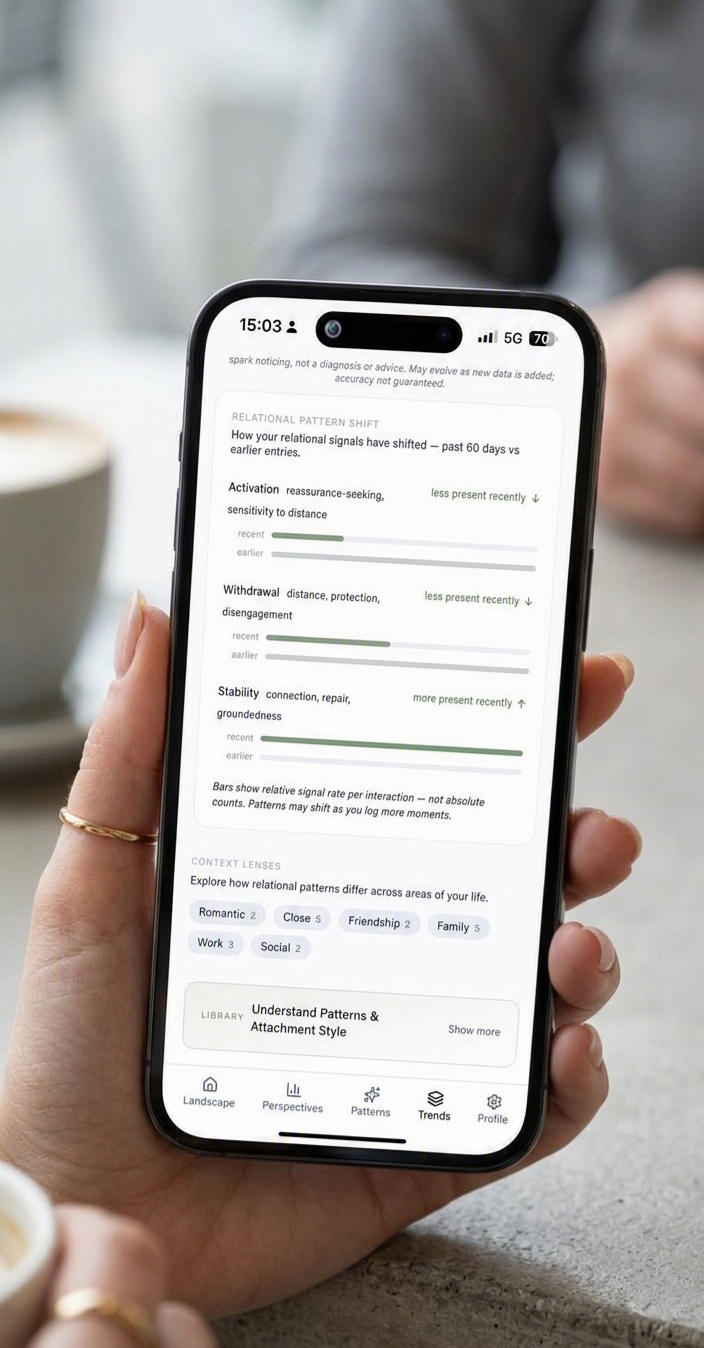
Rather than sorting you into a box, it is more honest — and more measurable — to watch three behavioural signals. Every attachment style is a particular mix of them.
Activation
Reassurance-seeking, sensitivity to distance. Rising activation is the behavioural surface of anxious attachment: more checking, more replaying, more need for confirmation that things are fine.
Withdrawal
Distance, protection, disengagement. Rising withdrawal is the surface of avoidant attachment: shorter answers, longer recovery time after intensity, a quiet preference for space over resolution.
Stability
Connection, repair, groundedness. Rising stability is the surface of secure functioning: bids that get met, ruptures that get repaired, closeness that does not cost you yourself.
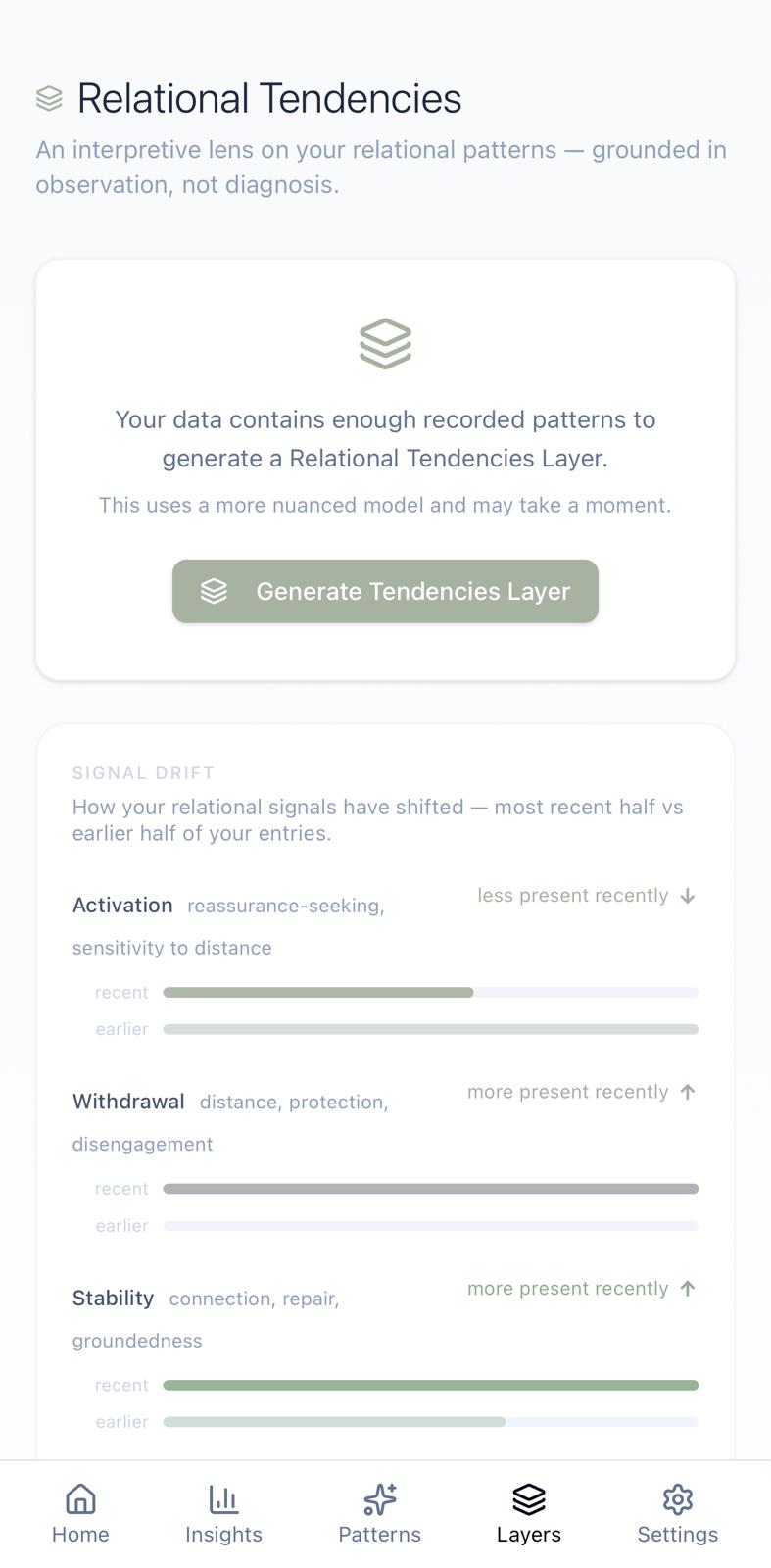
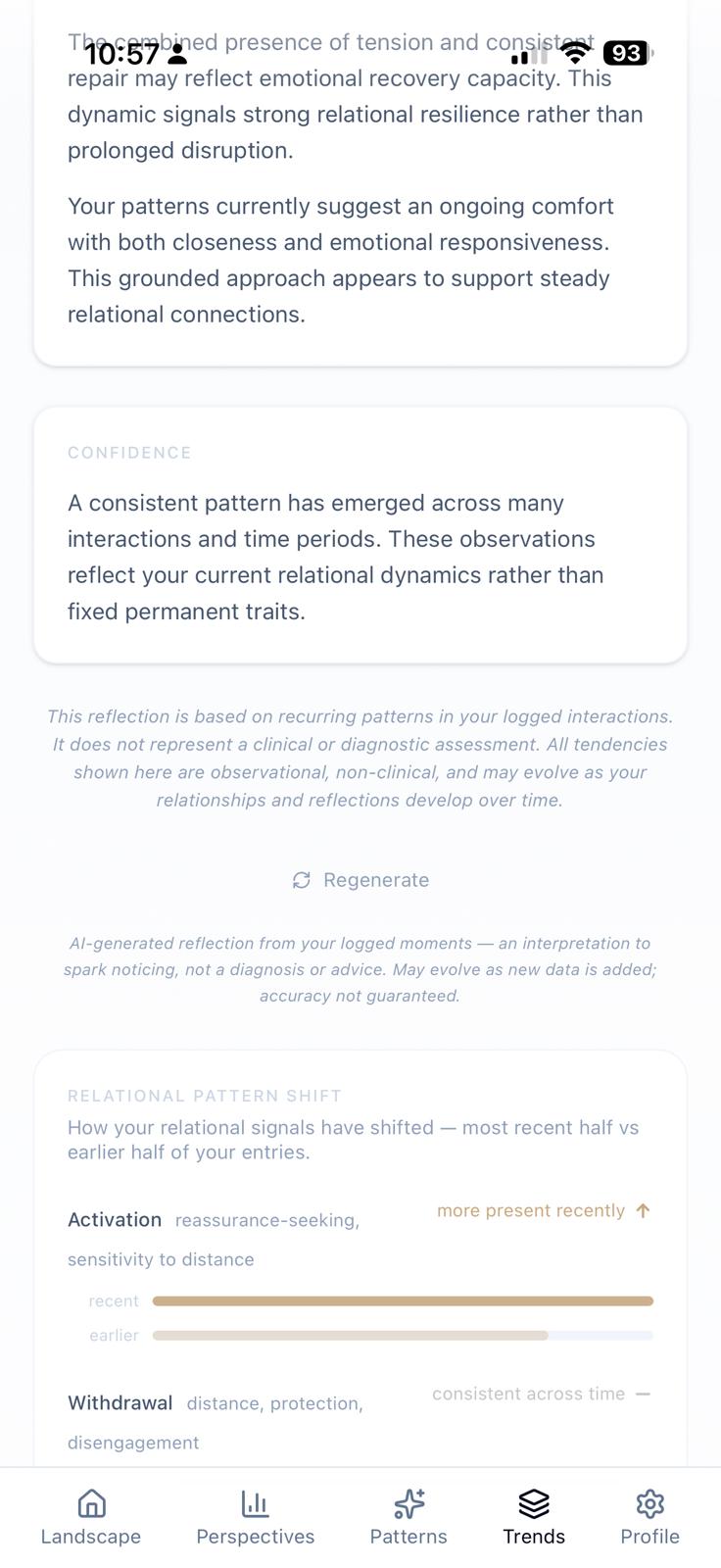
The advantage of signals over labels is direction. A label tells you where you are; signals tell you which way you are moving. 'Activation less present recently, stability more present recently' is a sentence about progress. 'You are anxiously attached' is a sentence about identity — and identity resists change by design.
Why you have a different style in different circles
Attachment is relationship-specific. You develop a working model of each significant relationship based on what that particular relationship has taught you about availability and repair. That is why the same week can contain a secure friendship, an anxious romance, and an avoidant relationship with a sibling.
- Romantic: usually the highest-stakes circle, and where activation runs hottest. Most people's 'style' is really their romantic style.
- Family: the oldest working models, often the most automatic. Withdrawal frequently peaks here because the pattern predates any adult skill you have.
- Friendship: often the securest circle, and therefore the most useful evidence that security is available to you at all.
- Work and social: lower intimacy, but activation and withdrawal still show up — in how you handle unanswered messages, ambiguous feedback, or exclusion.
Relationships that drift, and what drift actually is
Drift is the slow widening of the gap between how often you used to be in contact with someone and how often you are now. It is rarely a decision. Nobody chooses a Tuesday to stop calling a friend; the interval just stretches from a week to two, then to a month, and one day the relationship is a memory that still feels current.
Drift is worth watching because it is the single most reversible relational loss. A connection that has drifted for three weeks needs one message. A connection that has drifted for two years needs an explanation.
- Notice the interval, not the feeling. 'Usually every seven days, currently twenty-four' is information; 'we've grown apart' is a story built on top of it.
- Separate drift from withdrawal. Some connections drift because life got busy. Others drift because one side is protecting themselves. The remedy is different.
- Let some connections breathe. Not all drift is a problem to solve. Some relationships are seasonal and closing them gently is healthier than forcing frequency.
'Toxic traits' are usually attachment strategies under stress
A great deal of what circulates online as toxic behaviour is, on inspection, an attachment strategy that has escalated past its useful range. This is not an excuse — impact still counts, and some behaviour is genuinely abusive and should be named as such. But the framing changes what you can do about it.
- Constant checking and 'testing' behaviour is activation past its useful range — a search for certainty that no answer can supply.
- Stonewalling is withdrawal past its useful range — regulation that has become punishment, whether or not that was the intent.
- Hot-and-cold cycling is often disorganised patterning — reaching and flinching in the same breath.
- Score-keeping is usually a repair system that has failed: ruptures stack up because none of them close.
Used well, this framing removes the moral heat and leaves the pattern. 'He is avoidant' is a verdict. 'Withdrawal has been more present in this connection for two months, and repair has not followed the last three ruptures' is something two adults can actually discuss.
How to observe your own drift in 60 days
You do not need an app to do this, but you do need a record, because the thing you are measuring is the difference between two time periods and memory cannot hold that difference honestly.
- Log interactions, not moods. After a meaningful exchange, note who it was with, which circle they belong to, and whether you left it feeling more resourced or less.
- Tag the signal. Did you find yourself reaching for reassurance (activation), pulling back (withdrawal), or feeling grounded and repaired (stability)?
- Do it for eight weeks. Fewer than about thirty entries and you are reading noise.
- Compare halves. Recent four weeks against the earlier four, per circle. Direction is the output — not a label.
- Change one default. Pick the single most frequent automatic response and try one alternative. Then keep logging.
How LIMEN Energy handles this
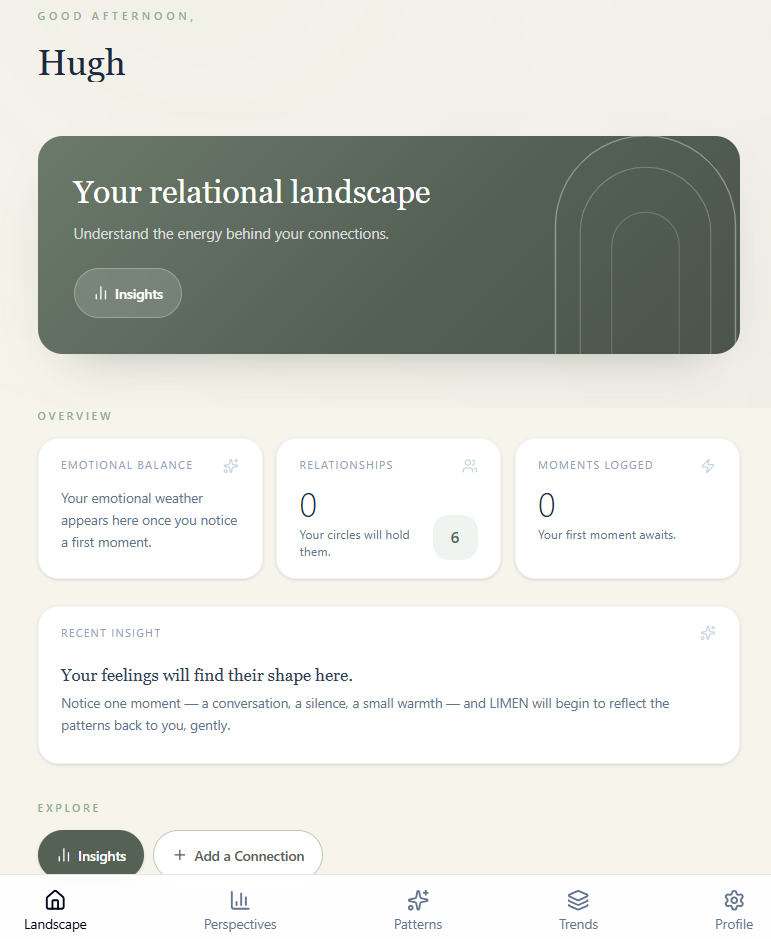
LIMEN Energy is a private reflection tool built around exactly this method. You log moments from your interactions; it reflects your Activation, Withdrawal and Stability signals back to you over time, compares recent entries against earlier ones, and lets you view the same signals through context lenses — romantic, close, friendship, family, work, social.
- Relational Pattern Shift: recent half versus earlier half, per signal, so you can see direction rather than guess it.
- Context lenses: the same signals broken down by circle, which is where the 'different style in different relationships' question gets answered empirically.
- Drift and reconnect: intervals for connections that have stretched beyond their usual rhythm, with the option to let some of them breathe.
- Relational Tendencies: an interpretive layer that appears only once you have enough recorded patterns for it to mean anything.
There is a free tier. Two months of light logging is enough to see your first real drift reading.
Frequently asked questions
+Can your attachment style change over time?
Yes. Attachment style is a set of learned responses measured on continuous dimensions, not a fixed trait. Meaningful shifts are usually visible across weeks to months, and larger changes — often called earned security — develop over years, typically through a long relationship with a steadier partner or through deliberate, structured reflection.
+Can you have different attachment styles with different people?
Yes, and most people do. Attachment is relationship-specific: you build a separate working model for each significant relationship. It is common to be secure with a close friend, anxious with a romantic partner, and avoidant with a family member at the same time.
+How long does it take to change your attachment style?
Small directional shifts in behaviour can appear within six to twelve weeks of consistent attention. A durable change in baseline usually takes a year or more of repeated corrective experience — consistent availability and reliable repair — rather than insight alone.
+What does it mean when a relationship drifts?
Drift is the gradual stretching of contact intervals without a decision being made. It differs from withdrawal, which is an active protective move. Drift is the most reversible relational loss: caught within weeks it needs one message, left for years it needs an explanation.
+Are toxic traits the same as attachment issues?
Often they overlap. Behaviour labelled toxic — constant checking, stonewalling, hot-and-cold cycling — is frequently an attachment strategy escalated past its useful range. That framing explains the behaviour without excusing its impact. Coercion, intimidation and control are not attachment styles and should be treated as safety issues.
+How can I track my attachment style without taking a quiz?
Log interactions rather than answering self-report questions. Record who the interaction was with, which circle they belong to, and whether you reached for reassurance, pulled back, or felt grounded. After about thirty entries, compare the recent half with the earlier half. LIMEN Energy automates this and has a free tier.
Free to start
See how your patterns have shifted
LIMEN Energy tracks Activation, Withdrawal and Stability across your circles and shows you the direction of travel — no quiz, no labels, just your own recorded patterns.
Continue reading
Attachment styles, explained without jargon
The four styles in plain language, before you track anything.
Relationship patterns
How activation and withdrawal show up as observable patterns.
What is relational energy?
The daily texture beneath attachment behaviour.
LIMEN Energy
See your own drift, per circle. Free to start.
Canonical URL: https://limen.systems/guides/how-attachment-styles-change