
Self-development guide
The 5 Inner Voice Modes: how your self-talk shapes your energy
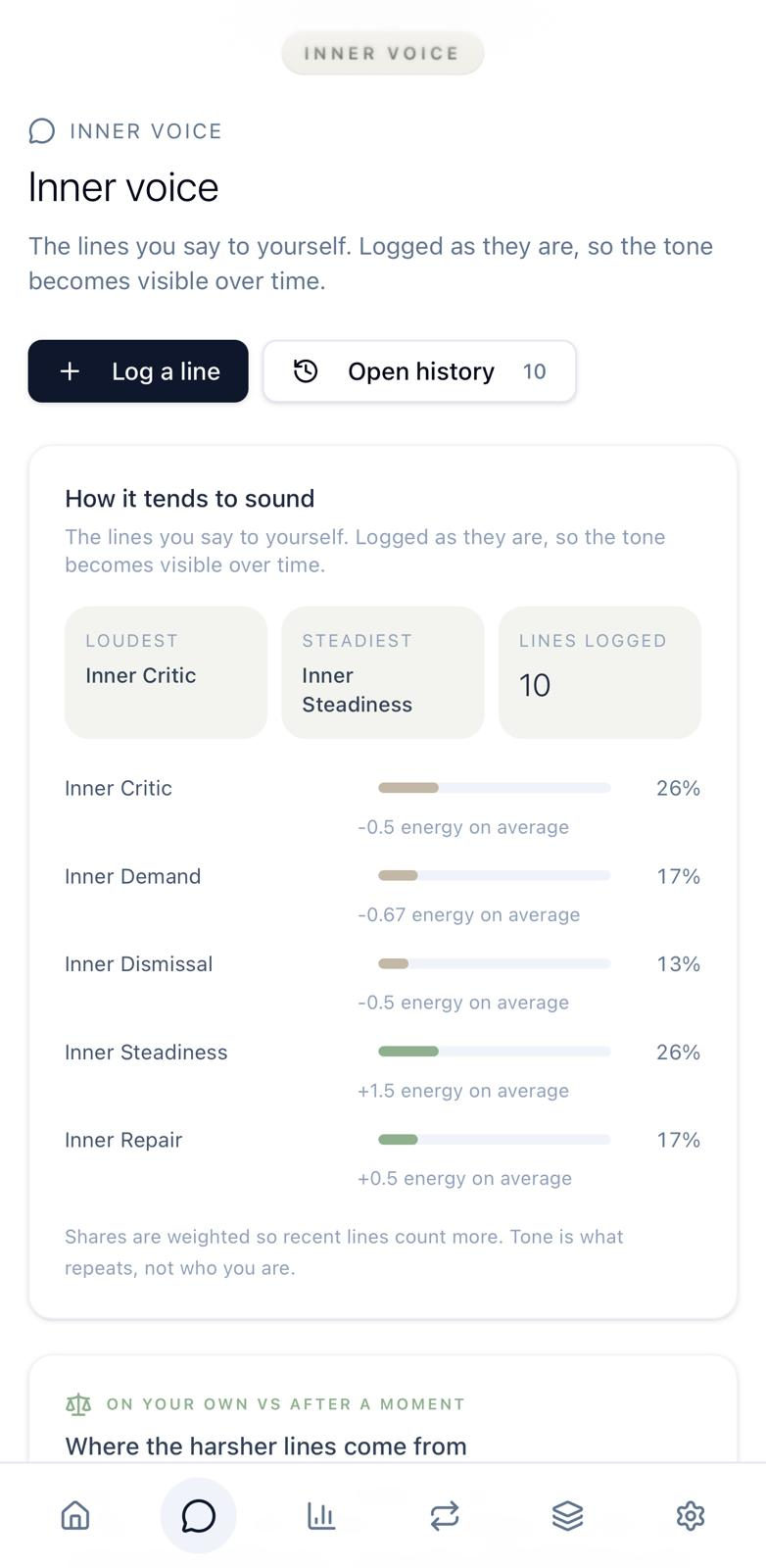
The sentences you tell yourself before and after a difficult moment are not background noise. They fall into recognisable modes — Inner Critic, Inner Demand, Inner Dismissal, Inner Steadiness and Inner Repair — and each one leaves a different energy cost. Seeing which mode runs loudest, and at what depth the line lives, is one of the fastest routes to understanding how you relate.
9 min read · Updated 25 September 2026
Why self-talk matters more than the moment itself
Most people remember a hard conversation by what was said out loud. What actually shapes the next day is usually the line said silently afterwards: "I always make it worse", "It doesn't matter", "That was hard, and I did what I could." The exchange lasts minutes. The line can run for weeks.
Self-talk works like a lens. The same moment, read through a harsh line, costs more energy than it would read through a steady one. That is why two people can leave the same meeting — one depleted, one fine.
The five modes at a glance
| Mode | What the line does | Typical sentence | Energy effect |
|---|---|---|---|
| Inner Critic | Rates you for what happened | "I'm an idiot for saying that." | High cost, lingers |
| Inner Demand | Sets a standard you must meet | "I should have handled it better." | Feels like motivation, costs over time |
| Inner Dismissal | Makes the moment smaller than it was | "It's fine, whatever." | Quiet cost that accumulates |
| Inner Steadiness | Holds the moment without a verdict | "That was hard. It was one conversation." | Low cost, protective |
| Inner Repair | Turns back toward the connection or yourself | "I'll reach out tomorrow." | Restores energy |
1. The Inner Critic
The Critic does not describe what happened; it grades you for it. It is usually the loudest mode people find when they begin noticing their self-talk, and rarely the most accurate one.
Signs it is running: the line contains a verdict about you ("stupid", "too much", "always mess it up"), and the energy drop outlasts the event.
2. The Inner Demand
Demand speaks in shoulds and musts. From the inside it feels like ambition or responsibility, which is why it is so easy to miss. Observed over weeks, it often turns out to be one of the more expensive modes — a standard that is never quite met.
3. The Inner Dismissal
Dismissal shrinks the moment — or your part in it — so it needs less attention. It reads as easy-going. Its cost only shows once the same line repeats and the unattended feeling surfaces somewhere else.
4. The Inner Steadiness
Steadiness names what happened without adding a verdict. It is the mode people most underestimate in themselves, because it does not announce itself the way the harsher modes do. Seeing how often it already shows up is often the real surprise.
5. The Inner Repair
Repair turns toward — toward the relationship, or toward yourself with some care. It is the mode most associated with what people describe as a good week, and it can be practised deliberately.
Mode is half the picture: how deep does the line live?
The same mode means different things depending on where the line sits. LIMEN reads self-talk against Dilts' logical levels:
- Environment — tied to a setting: "In that room I always freeze."
- Behaviour — about something you did: "I snapped at them."
- Capability — about what you can do: "I can't handle conflict."
- Beliefs and values — stated as settled truth: "People always leave."
- Identity — about who you are: "I'm someone who ruins things."
"That went badly" and "I am bad at this" can both be Inner Critic. The first lives at behaviour and is highly workable. The second has travelled to identity, where effort rarely helps and noticing does.
How to notice your own modes
- After a moment of tension, write down the exact sentence you told yourself — word for word.
- Note whether it arrived on its own or after a specific moment, and in which setting.
- Name the mode, without judging it. A Critic line is data, not a failure.
- Rate the energy it cost you, lightly.
- Read the lines back after two or three weeks. Look for the loudest mode, the steadiest one, and where the harsher lines come from.
For coaching clients and practitioners
Inner Voice gives a client a legible pattern they found on their own — not a label from outside. A coach can then decide with them whether the work is behavioural (a habit in one setting) or deeper (a belief or identity-level line). LIMEN observes; it never diagnoses, scores or advises.
Frequently asked questions
+What are the five Inner Voice modes?
Inner Critic, Inner Demand, Inner Dismissal, Inner Steadiness and Inner Repair — five recognisable ways self-talk responds to a difficult moment.
+Is the Inner Critic always bad?
No mode is bad. The Critic is simply often loud and costly. The aim is to notice how often it arrives and what precedes it, not to silence it.
+How does self-talk affect energy?
The line you tell yourself afterwards shapes how much a moment costs you. Harsh or demanding lines tend to extend the drain; steady or repairing lines tend to contain it.
+Is this a psychological assessment?
No. LIMEN is a reflective tool. Modes and depths are observational readings you can edit at any time; nothing is scored or diagnosed.
Hear your own modes
One line is a moment. Ten lines are a pattern.
LIMEN Energy keeps your Inner Voice history, shows which mode runs loudest and what it costs you. Private, browser-based, free to start.
Continue reading
Canonical URL: https://limen.systems/guides/inner-voice-modes