
Self-development guide
Robert Dilts' Logical Levels: why changing behaviour isn't always enough
Robert Dilts' logical levels describe six depths at which a pattern can live: environment, behaviour, capability, beliefs and values, identity and purpose. A change made at one level rarely holds if the pattern is anchored deeper. That is why some habits shift in a week and others return for years: the work was done at the wrong depth.
8 min read · Updated 10 October 2026
Why behaviour change often doesn't last
Most self-improvement advice works at the level of behaviour: say no more often, speak up in meetings, stop checking your phone after an argument. Sometimes it works. Often it holds for a few weeks and then quietly fades.
The reason is rarely willpower. If the habit is held in place by a belief ("if I speak up, I'll be dismissed") or by identity ("I'm not someone people listen to"), changing the behaviour alone asks the surface to move while the root stays put.
The six logical levels
Dilts, building on the work of Gregory Bateson, arranged the levels from the most outward to the most inward. Each one organises the levels beneath it.
| Level | The question | Example in a relationship |
|---|---|---|
| Environment | Where, when, with whom? | I snap more when we talk late at night. |
| Behaviour | What do I do? | I go quiet after a disagreement. |
| Capability | How do I do it? What can I do? | I don't know how to name what I need mid-conversation. |
| Beliefs and values | Why? What do I hold as true or important? | Conflict means the connection is in danger. |
| Identity | Who am I? | I'm the one who keeps the peace. |
| Purpose | What for? What am I part of? | Belonging matters more to me than being right. |
The same pattern can live at different depths
Two people can both go quiet after an argument and need completely different work. For one, it happens only in a cramped evening routine: that is environment, and changing when hard conversations happen may be enough. For the other, silence protects a belief that disagreement ends connections: no change in timing will touch it.
The same applies within one life. You may stay in contact at work and make room at home. The behaviour differs by setting, which tells you the pattern is held by something specific to that circle, not by who you are everywhere.
Matching the change to the level
- Environment: change the setting. Timing, place, channel, who is present.
- Behaviour: practise one alternative action in a small, repeatable situation.
- Capability: learn a skill — naming a need, pausing, asking a clarifying question.
- Beliefs and values: examine the rule underneath. Where did it come from, and is it still true?
- Identity: notice the story of who you are that the pattern protects, and whether it still fits.
- Purpose: reconnect with what you are relating for. Purpose often reorganises everything below it.
"One line is a moment. Ten lines are a pattern. The depth is what tells you what can change."
Your self-talk reveals the depth
The quickest way to locate a pattern is to listen to the line you tell yourself afterwards. "That went badly" lives at behaviour. "I can't do this" points to capability. "People always leave" is a belief. "I am bad at this" has reached identity.
How LIMEN Energy reads the levels: Where This Lives
In LIMEN Energy, Foundations includes Where This Lives: a reading of your logged moments and inner lines across six depths — Purpose, Identity, Beliefs and values, Capability, Behaviour, Environment. It shows where your tendencies sit and how each depth tends to change.
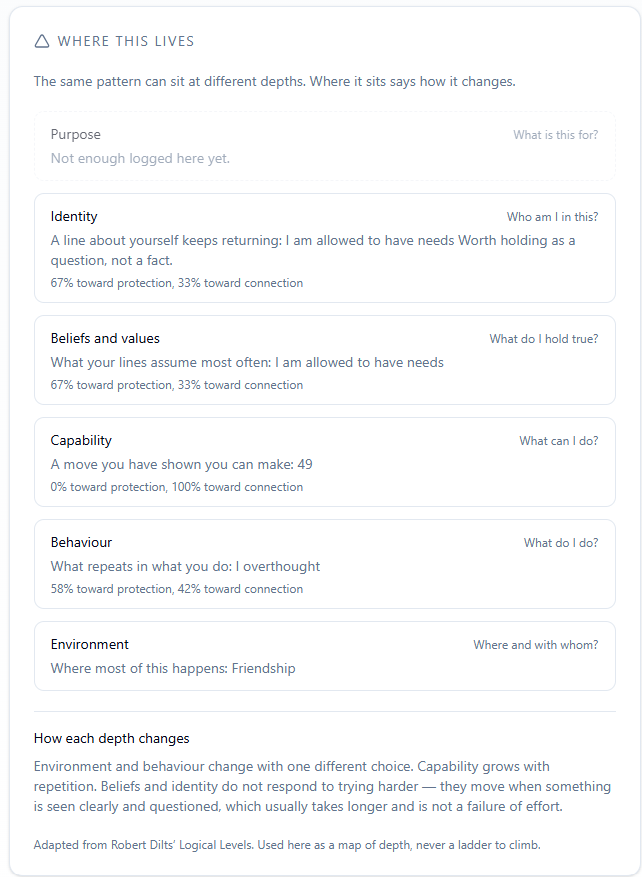
It is a reflective device, not an assessment. LIMEN does not diagnose, score or advise; it makes the depth visible so you can choose where to put your effort.
For coaching clients
The logical levels help decide the coaching conversation: a behavioural experiment, a skill to build, or a slower conversation about belief and identity. Arriving with your own observed depth gives the session concrete material. Your coach remains a non-directive thinking partner.
Frequently asked questions
+What are Robert Dilts' logical levels?
A model of six depths at which change can happen: environment, behaviour, capability, beliefs and values, identity and purpose. Higher levels organise the ones beneath them.
+Why doesn't changing my behaviour stick?
Often because the behaviour is held in place by a belief or by identity. Changing the surface while the root stays put usually fades within weeks.
+How do I find which level a pattern lives at?
Listen to your self-talk, and notice whether the pattern changes by setting. A pattern that appears only in one circle usually sits shallower than one that follows you everywhere.
+Does LIMEN use logical levels?
Yes. Where This Lives, part of Foundations in LIMEN Energy, reads your logged moments across six depths. It is observational and never assigns a label.
Find the depth
See where your patterns actually live.
LIMEN Energy turns moments and inner lines into a picture of the depth your tendencies sit at. Private, browser-based, free to start.
Continue reading
Canonical URL: https://limen.systems/guides/logical-levels