
Guide
15 ways to get better at relationships — in every circle of your life
Getting better at relationships is not a personality upgrade. It is a set of small, repeatable observations: noticing which interactions leave you steadier, which leave you drained, which patterns repeat across people, and how fast things get repaired after friction. This guide gives you fifteen ways to do that — across friendships, close friendships, family, work and romantic life — and shows where a reflection tool like LIMEN Energy does the remembering for you.
11 min read · Updated 09 September 2026
Why 'relationship advice' usually fails you
Almost all relationship advice is written for one circle — the romantic one — and then quietly assumed to apply everywhere else. It doesn't. The friendship that thins out over eight months, the sibling you brace for before every call, the colleague who leaves you tired without a single harsh word: these follow the same mechanics as romance, but the advice written for couples rarely fits them.
The mechanics that generalise are simple. Every interaction leaves a residue. Residues repeat and become patterns. Patterns drift over months. Damage either gets repaired or it accumulates. That is true of a marriage, a friendship group, a parent, a manager and a neighbour alike.
Ways 1–5: see what is actually happening
The first five are about observation. None of them require a conversation, a confrontation, or anyone else's participation.
- 1. Name the residue, not the event. After an interaction, skip the story of what happened and record how it left you: nourished, steady, drained, activated. The residue is the data; the story is interpretation.
- 2. Log the small ones. Big events are remembered anyway. Relationships are decided by the ordinary Tuesday exchanges nobody records — those are the ones worth capturing.
- 3. Count across circles, not just the closest one. Track a friend, a parent, a colleague and a partner in the same place. The comparison is where the insight lives.
- 4. Distrust your memory on purpose. Recall is dominated by the most recent and most intense moments. A relationship that has been steady for eleven weeks and hard for one will be remembered as hard.
- 5. Separate the signal types. Activation (charge, tension, intensity), withdrawal (distance, flatness, avoidance) and stability (calm, predictability) behave differently. Lumping them into 'good' and 'bad' loses most of the information.
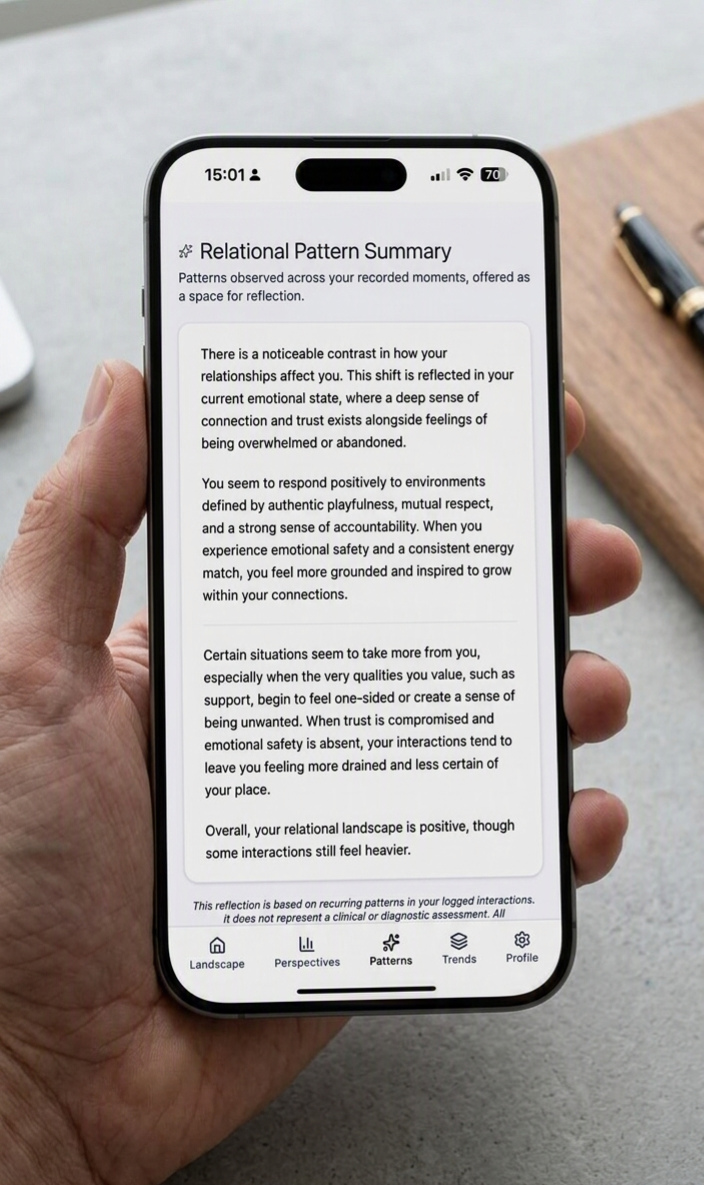
Ways 6–10: work each circle on its own terms
You are not the same relational person everywhere. Most people are secure with friends and anxious with a parent, or steady at home and avoidant at work. Treating every circle with one strategy is why progress stalls.
- 6. Friendships: measure frequency against residue. A friendship you see weekly that consistently leaves you flat is costing more than a friendship you see twice a year that restores you.
- 7. Close friendships: check whether reaching gets met. The difference between a friend and a close friend is not history, it is response rate. Notice how often your small bids get a real answer.
- 8. Family: track the pattern, not the relative. 'My mother is difficult' is unusable. 'Calls after 8pm on Sundays end badly four times out of five' is something you can change.
- 9. Work: watch the cumulative drain, not the incidents. Work relationships rarely break loudly. They erode through dozens of interactions that are individually fine and collectively depleting.
- 10. Romantic: watch consistency, not intensity. Peaks feel like evidence and are not. Whether the same behaviour shows up on unremarkable weeks is the actual predictor.
| Circle | What usually goes wrong | What to observe |
|---|---|---|
| Friendship | Slow, unspoken thinning out | Residue per meeting; who initiates |
| Close friendship | Reaching stops getting met | Response to small bids |
| Family | Old roles reactivate on contact | Recurring triggers and timing |
| Work | Quiet, cumulative depletion | Energy after routine interactions |
| Romantic | Intensity mistaken for health | Consistency between peaks; repair speed |
Ways 11–15: repair faster and notice drift
- 11. Know your repair time. Not whether you argue, but how long it takes to come back. Reducing that number by a day changes a relationship more than any conversation technique.
- 12. Repair the small ruptures. Most damage is never addressed because it was too minor to raise — and then repeats two hundred times.
- 13. Bring evidence, not accusation. 'Six of our last ten evenings ended flat' opens a conversation. 'You never make an effort' closes one.
- 14. Watch the drift, not the day. Relationships change over months, in increments too small to feel. Reviewing a quarter at a glance shows what no single day can.
- 15. Adjust one thing, then re-measure. Change a single variable — timing, frequency, channel, who initiates — and check the residue four weeks later. That is the whole loop.
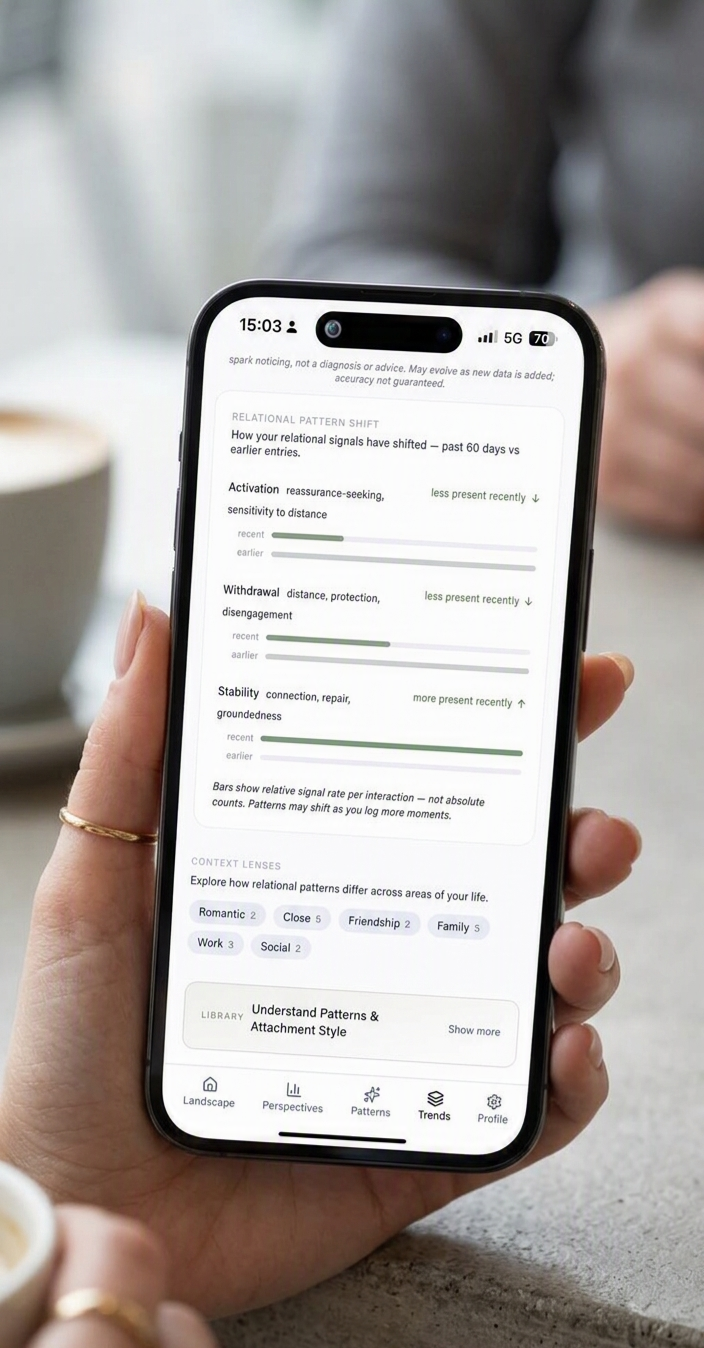
None of this is therapy and none of it is coaching. It is observation with structure: the part most people skip, because holding months of relational detail in your head is not something attention can do.
Where LIMEN Energy fits
LIMEN Energy is a private, browser-based reflection tool for exactly this loop. You log a moment in a sentence. It classifies the signal, holds the history across every circle you track — friendships, family, work, romantic — and shows the patterns, trends, stability and drift back to you.
- Track connections across all circles in one place, not one relationship type.
- See recurring patterns instead of remembering the last incident.
- Watch stability and drift over weeks and months.
- No download, no phone permissions, no notifications — it runs in your browser at your own rhythm.
It is free to start, and the free check-in takes about three minutes if you want to see the method before committing to anything.
Frequently asked questions
+Can this really apply to friendships and work, not just couples?
Yes — that is the point. The underlying mechanics (residue, pattern, repair, drift) are identical across circles. What changes is what goes wrong in each: friendships thin out silently, family reactivates old roles, work depletes cumulatively, romance gets misread through intensity.
+How long before I see anything useful?
Two to three weeks of light logging is usually enough for the first patterns to surface. Drift across circles takes about three months to become clearly visible, because that is the timescale on which it happens.
+Do the other people need to be involved?
No. Observation needs one person. Repair eventually needs two, but you will approach that conversation with something specific rather than a feeling of vague distance.
+Isn't tracking relationships a bit clinical?
The tracking is of connections and interactions, not of people. You are recording how exchanges leave you, which is information you already carry — just unstructured and prone to being overwritten by the most recent bad week.
+Is LIMEN Energy therapy?
No. It is an educational self-reflection tool. It does not diagnose, treat or advise, and it is not a substitute for a therapist, counsellor or medical professional.
+Do I need to install anything?
No. LIMEN Energy runs in your browser. There is no app store download, no device permissions and no push notifications — you can add it to your home screen if you want it to behave like an app.
Start with one connection
Get better at relationships by seeing them clearly
LIMEN Energy holds the history across every circle in your life and shows you the patterns, stability and drift. Private, browser-based, free to start.
Continue reading
What people really look for in a relationship
Responsiveness, predictability and repair — the three that decide it.
Understanding relationship patterns
How single signals become the patterns you can actually change.
How attachment styles change over time
Why you're secure in one circle and anxious in another.
What LIMEN Energy does
A tour of what you can log and what the app shows back.
Canonical URL: https://limen.systems/guides/improve-your-relationships